UK School Years by Age: Cut-Off Dates, Key Stages & Year Group Guide
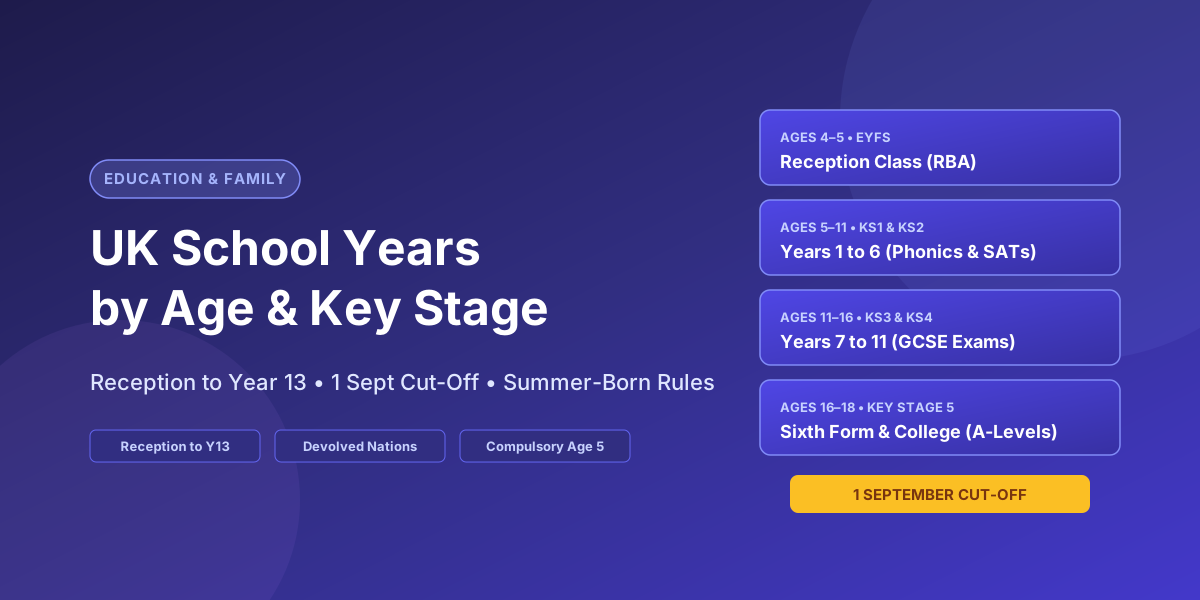
Direct Answer: If you are asking what school year is my child in uk, under the statutory september school age cut off uk system children are placed into academic year groups based on their age on 1 September. The key stages uk school age framework structures education from Reception (ages 4–5) through Key Stages 1 to 4 (Years 1 to 11, ages 5–16) and Post-16 / Key Stage 5 (Years 12 to 13, ages 16–18) as detailed in our uk school years by age guide.
Understanding uk school years by age can be challenging for parents registering their first child, families relocating to Britain, or guardians planning educational milestones. Unlike countries that assign grades strictly by calendar birth year (January to December), the UK academic calendar operates under a strict september school age cut off uk cycle (1 September to 31 August). You can check what school year is my child in uk instantly using our interactive School Year Checker Calculator.
This comprehensive guide details the complete key stages uk school age framework across all stages (EYFS, KS1, KS2, KS3, KS4, and KS5), breaks down statutory assessment checkpoints (Phonics, MTC, SATs, and GCSEs), explains compulsory school starting ages, and provides clear guidance on summer-born deferral rights and devolved nation differences in Scotland, Wales, and Northern Ireland.
What School Year Is My Child In UK? (Master UK School Years by Age Table)
The table below provides the authoritative age-to-year group mapping across England and Wales under the National Curriculum framework, allowing you to easily verify what school year is my child in uk based on their birth date.
| Child Age on 1 Sept | Birthday Range (Academic Cohort) | School Year Group | Key Stage / Phase | School Type | Statutory Assessments |
|---|---|---|---|---|---|
| 3 turning 4 | 1 Sept 2022 – 31 Aug 2023 | Nursery / Pre-School | Early Years (EYFS) | Nursery / Early Years | Early learning goals |
| 4 turning 5 | 1 Sept 2021 – 31 Aug 2022 | Reception Class | Early Years (EYFS) | Infant / Primary | Reception Baseline (RBA) |
| 5 turning 6 | 1 Sept 2020 – 31 Aug 2021 | Year 1 | Key Stage 1 (KS1) | Infant / Primary | Phonics Screening Check |
| 6 turning 7 | 1 Sept 2019 – 31 Aug 2020 | Year 2 | Key Stage 1 (KS1) | Infant / Primary | Teacher Assessments |
| 7 turning 8 | 1 Sept 2018 – 31 Aug 2019 | Year 3 | Key Stage 2 (KS2) | Junior / Primary | KS2 Curriculum Tracking |
| 8 turning 9 | 1 Sept 2017 – 31 Aug 2018 | Year 4 | Key Stage 2 (KS2) | Junior / Primary | Multiplication Tables Check |
| 9 turning 10 | 1 Sept 2016 – 31 Aug 2017 | Year 5 | Key Stage 2 (KS2) | Junior / Primary | 11+ Grammar Prep |
| 10 turning 11 | 1 Sept 2015 – 31 Aug 2016 | Year 6 | Key Stage 2 (KS2) | Junior / Primary | Statutory KS2 SATs |
| 11 turning 12 | 1 Sept 2014 – 31 Aug 2015 | Year 7 | Key Stage 3 (KS3) | Secondary / High School | Secondary Transition |
| 12 turning 13 | 1 Sept 2013 – 31 Aug 2014 | Year 8 | Key Stage 3 (KS3) | Secondary / High School | Progress Assessments |
| 13 turning 14 | 1 Sept 2012 – 31 Aug 2013 | Year 9 | Key Stage 3 (KS3) | Secondary / High School | GCSE Options Selection |
| 14 turning 15 | 1 Sept 2011 – 31 Aug 2012 | Year 10 | Key Stage 4 (KS4) | Secondary / High School | GCSE / BTEC Courses |
| 15 turning 16 | 1 Sept 2010 – 31 Aug 2011 | Year 11 | Key Stage 4 (KS4) | Secondary / High School | GCSE Exams (May–June) |
| 16 turning 17 | 1 Sept 2009 – 31 Aug 2010 | Year 12 (Lower Sixth) | Key Stage 5 (KS5) | Sixth Form / College | A-Levels / T-Levels |
| 17 turning 18 | 1 Sept 2008 – 31 Aug 2009 | Year 13 (Upper Sixth) | Key Stage 5 (KS5) | Sixth Form / College | A-Level Finals / UCAS |

Early Years Foundation Stage (Nursery & Reception, Ages 3–5)
The Early Years Foundation Stage (EYFS) covers developmental learning from birth to age 5. In school settings, this comprises Nursery (ages 3–4) and Reception class (ages 4–5). Within the first six weeks of starting Reception, children complete the statutory Reception Baseline Assessment (RBA)—a short, interactive 20-minute check of early language, communication, and mathematical understanding.
Primary School: Key Stage 1 (Years 1–2, Ages 5–7)
Key Stage 1 (KS1) represents the formal start of the National Curriculum. In June of Year 1 (ages 5–6), all pupils complete the statutory Phonics Screening Check, reading 40 words to assess decoding capabilities. Year 2 (ages 6–7) consolidates KS1 learning with teacher-assessed benchmarks in reading, writing, and mathematics.
Primary School: Key Stage 2 (Years 3–6, Ages 7–11)
Key Stage 2 (KS2) spans four years of primary education. In Year 4, pupils sit the statutory online Multiplication Tables Check (MTC) up to 12 × 12. In May of Year 6, all pupils take statutory Key Stage 2 SATs in English Reading, Grammar, Punctuation & Spelling, and Mathematics.
Secondary School: Key Stage 3 (Years 7–9, Ages 11–14)
Pupils transfer to secondary school at the start of Year 7 (age 11 turning 12). Key Stage 3 broadens academic depth across 12+ separate subjects taught by specialist subject teachers. During Year 9, students select their optional GCSE subjects.
Secondary School: Key Stage 4 (Years 10–11 / GCSEs, Ages 14–16)
Key Stage 4 (KS4) prepares students for national GCSE examinations across core and optional subjects, evaluated on the 9 to 1 numerical grading scale where Grade 9 is exceptional achievement and Grade 4/5 is a pass.
Post-16 & Sixth Form: Key Stage 5 (Years 12–13, Ages 16–18)
Under the Education and Skills Act 2008, young people in England must participate in education or training until their 18th birthday. Students choose between A-Levels (academic route for UCAS), T-Levels (technical route with industry placements), or vocational apprenticeships.
How Does the September School Age Cut Off UK Rule Work?
In England and Wales, admissions are governed by the DfE School Admissions Code under the statutory september school age cut off uk framework. A child's school year group is determined strictly by their age on 1 September:
- A child born on 31 August 2021 turns 4 on 31 August 2025 and enters Reception in September 2025 as the youngest in the year group.
- A child born on 1 September 2021 turns 4 on 1 September 2025 and starts Reception in September 2026 as the oldest in the year group.
When Does a Child Reach Legal Compulsory School Age?
Under Section 8 of the Education Act 1996, compulsory school age begins on the prescribed day following a child's fifth birthday (31 December, 31 March, or 31 August). Parents may legally choose part-time attendance or defer start dates until this statutory date.
What Are the Rules for Summer-Born Children (April to August Birthdays)?
Parents of summer-born children (born 1 April – 31 August) have the legal right under DfE guidance to request delayed Reception entry at age 5 instead of going directly into Year 1, allowing them to be educated out of their chronological cohort.
How Do UK School Years Compare Across England, Scotland, Wales, and Northern Ireland?
| Feature / Metric | England | Wales | Scotland | Northern Ireland |
|---|---|---|---|---|
| Cut-Off Date | 1 September | 1 September | Last day of February | 1 July |
| Primary School | Reception, Years 1–6 | Reception, Years 1–6 | Primary 1 (P1)–P7 | Primary 1 (P1)–P7 |
| Secondary School | Years 7–11 | Years 7–11 | Secondary S1–S6 | Years 8–14 |
| Post-16 Rule | Compulsory to age 18 | Can leave at 16 | Can leave at 16 | Can leave at 16 |
| Qualifications | GCSEs, A-Levels, T-Levels | GCSEs, A-Levels | National 4/5, Highers | GCSEs, A-Levels |
Frequently Asked Questions
How does the september school age cut off uk rule work?
Under the september school age cut off uk framework, a child's academic year group is determined by their age on 1 September. Children who turn the threshold age on or before 31 August enter the higher year group for that autumn term.
What school year is my child in uk?
To answer what school year is my child in uk, check their age on 1 September: age 4 is Reception, age 5 is Year 1 (KS1), age 7 is Year 3 (KS2), age 11 is Year 7 (KS3), and age 14 is Year 10 (KS4/GCSE).
What are the key stages uk school age brackets?
The key stages uk school age brackets are: EYFS (ages 3–5), Key Stage 1 (ages 5–7, Years 1–2), Key Stage 2 (ages 7–11, Years 3–6), Key Stage 3 (ages 11–14, Years 7–9), Key Stage 4 (ages 14–16, Years 10–11), and Key Stage 5 (ages 16–18, Years 12–13).
How do uk school years by age work for primary and secondary school?
The uk school years by age system structures primary education from Reception to Year 6 (ages 4 to 11) and secondary education from Year 7 to Year 11 (ages 11 to 16), followed by post-16 Sixth Form Years 12 and 13 (ages 16 to 18).
When is a child legally required to start school in England?
Compulsory school age legally begins on the prescribed day following a child's 5th birthday (31 December, 31 March, or 31 August). While most children enter Reception at age 4, parents are not legally obliged to enroll them until the term following their 5th birthday.
Can summer-born children delay starting Reception until age 5?
Yes, parents of summer-born children (born between 1 April and 31 August) have the legal right under DfE School Admissions Code guidance to request that their child starts Reception at age 5 instead of going directly into Year 1, being educated outside their chronological age group.
What year group does secondary school start in the UK?
Secondary school begins in Year 7 (Key Stage 3) in England and Wales for children aged 11 turning 12. Primary school ends at the completion of Year 6.
Do UK students have to stay in school until age 18?
Under the Education and Skills Act 2008 in England, young people must remain in education or training until their 18th birthday. This can be full-time study (such as A-Levels, T-Levels, or vocational college), an apprenticeship, or part-time education alongside working 20+ hours per week.
How do Scottish school years differ from England?
Scotland uses a cut-off date of the end of February rather than 1 September. Scottish primary education runs from Primary 1 (P1) to Primary 7 (P7) for ages 4.5 to 12, followed by Secondary S1 to S6 for ages 12 to 18 under the Curriculum for Excellence.
What statutory national tests do children take in English primary schools?
Statutory assessments include the Reception Baseline Assessment (RBA), the Year 1 Phonics Screening Check (age 5–6), the Year 4 Multiplication Tables Check (age 8–9), and the Year 6 Key Stage 2 SATs (age 10–11 in reading, maths, and grammar).