
HMRC Mileage Allowance Rates 2026: The 45p vs 25p Rule & Claiming Tax Relief
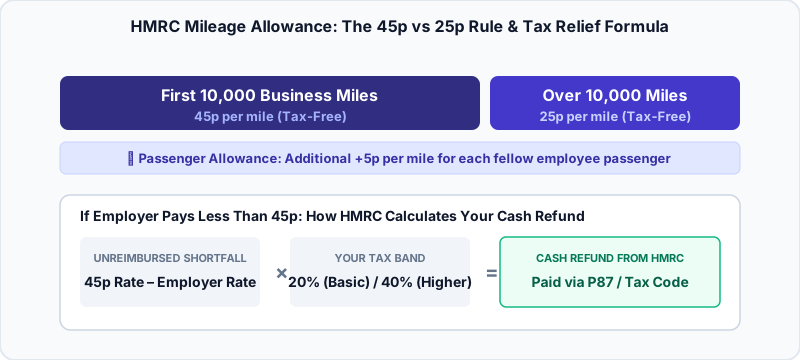
Direct Answer: HMRC Approved Mileage Allowance Payments (AMAP) permit employees using personal cars or vans for business travel to receive up to 45p per mile for the first 10,000 business miles, dropping to 25p per mile thereafter, completely tax-free. If your employer pays less than 45p, you can claim tax relief on the shortfall using Form P87 or a Self Assessment tax return.
If you drive your private car, electric vehicle, motorbike, or bicycle for work-related journeys across the UK, you are legally entitled to claim business travel expenses. Under statutory rules established by HM Revenue and Customs (HMRC), employers can reimburse your business driving without deducting Income Tax or National Insurance contributions, up to designated statutory caps.
However, millions of British employees lose out on hundreds of pounds in statutory tax refunds each year because their employer pays a lower reimbursement rate—such as 25p or 30p per mile—or pays no travel allowance at all.
What Are the HMRC Approved Mileage Allowance Rates in 2026?
Under Part 4, Chapter 2 of the Income Tax (Earnings and Pensions) Act 2003 (ITEPA 2003), HMRC sets the Approved Mileage Allowance Payments (AMAP) rates. These rates reflect the average running costs of operating a vehicle for business purposes, covering fuel/electricity, insurance, road tax, servicing, tyres, and annual vehicle depreciation.
| Vehicle Type | First 10,000 Business Miles | Miles Over 10,000 | Passenger Rate (Per Colleague) |
|---|---|---|---|
| Cars and Vans (Petrol, Diesel, Hybrid, Electric) | 45p per mile | 25p per mile | +5p per mile |
| Motorcycles | 24p per mile | 24p per mile | N/A |
| Bicycles | 20p per mile | 20p per mile | N/A |
The 45p vs 25p Rule for Cars and Vans
For cars and light commercial vans, the statutory rate is split into two distinct tiers within each UK tax year (running from 6 April to 5 April):
- Initial 10,000 Business Miles: You are allowed up to 45p per mile. This higher rate accounts for fixed standing vehicle costs such as annual depreciation, road tax, and routine servicing.
- Over 10,000 Business Miles: Once your total business mileage passes the 45p per mile threshold (10,000 miles), the statutory rate drops to 25p per mile for all subsequent business miles in that tax year. At this point, fixed vehicle ownership costs are deemed recovered, and the 25p allowance covers ongoing marginal operating costs (primarily fuel and wear-and-tear).
- Reset Each Tax Year: The 10,000-mile counter resets to zero every year on 6 April.
Motorcycle and Bicycle Statutory Rates (24p and 20p)
HMRC provides flat-rate mileage allowances for two-wheeled transport that do not taper after 10,000 miles:
- Motorcycles: A flat 24p per mile applies to all business mileage throughout the tax year.
- Bicycles: Cyclists using their own pedal bicycle for business journeys can claim a flat 20p per mile. This allowance encourages active travel and covers mechanical wear, chains, tyres, and maintenance.
Passenger Payments: The Extra 5p Tax-Free Allowance
If you drive colleagues or fellow employees on business journeys, you can claim an additional 5p per passenger per business mile tax-free under Section 233 of ITEPA 2003.
Rules for claiming passenger allowance:
- The passenger must also be an employee of your organisation.
- The journey must be a genuine business trip for that passenger.
- If your employer does not pay passenger allowance, you cannot claim tax relief from HMRC for passengers (passenger relief cannot be claimed via Form P87; it is only available as an employer tax-free reimbursement).
How to Claim Mileage Tax Relief When Your Employer Underpays
Many employers reimburse their staff below the HMRC approved 45p rate—for example, paying 20p, 25p, or 30p per mile—while some non-profit organisations or small businesses pay 0p. When your employer does not pay the full AMAP rate, UK tax law allows you to claim Mileage Allowance Relief (MAR) directly from HMRC.
Calculating Your Mileage Allowance Relief (MAR) Shortfall
Mileage Allowance Relief is calculated as the difference between the total HMRC approved allowance and the total reimbursement actually paid by your employer:
MAR Unreimbursed Shortfall = (Total Business Miles × Statutory Rate) - Total Employer Reimbursement
Example: Suppose you drive 6,000 business miles in your car during the tax year, and your employer pays you 25p per mile:
- HMRC Approved Amount:
6,000 miles × 45p = £2,700 - Employer Reimbursed Amount:
6,000 miles × 25p = £1,500 - Unreimbursed Mileage Shortfall:
£2,700 - £1,500 = £1,200
The Real Cash Value: How Tax Bands (20% vs 40%) Determine Your Refund
A common misconception is that HMRC sends you a cheque for the full £1,200 shortfall. Mileage Allowance Relief is a tax deduction, not a direct cash grant. It reduces the amount of your gross employment income that is subject to Income Tax. To see how deductions impact your net earnings, check our Take-Home Pay Guide.
The actual cash money deposited into your bank account depends on your highest marginal income tax band:
- Basic Rate Taxpayers (20%): You receive 20% of the shortfall. On a £1,200 shortfall, your tax refund is
£1,200 × 20% = £240.00. - Higher Rate Taxpayers (40%): You receive 40% of the shortfall. On a £1,200 shortfall, your tax refund is
£1,200 × 40% = £480.00. - Additional Rate Taxpayers (45%): You receive 45% of the shortfall. On a £1,200 shortfall, your tax refund is
£1,200 × 45% = £540.00.
How to Submit Your Claim: Form P87 vs Self Assessment Tax Return
Depending on the size of your total allowable employment expenses, you will claim your tax refund either through HMRC's online P87 portal or via a formal Self Assessment return.
Claiming Online via Form P87 (Expenses Up to £2,500)
If your total unreimbursed employment expenses (including mileage, uniform allowances, and professional subscriptions) are £2,500 or less in a single tax year, you should use Form P87:
- Log into your personal tax account on GOV.UK using your Government Gateway user ID.
- Select the option to "Claim tax relief for your job expenses".
- Enter your employer details, vehicle registration number, total business miles driven, and the amount reimbursed by your employer.
- HMRC will process the claim and issue your repayment or issue an updated PAYE tax code notification (P2 notice).
You can also download and print a physical postal Form P87 and post it directly to: Pay As You Earn and Self Assessment, HM Revenue and Customs, BX9 1AS.
Self Assessment Rules (Claims Exceeding £2,500)
If your total unreimbursed employment expenses exceed £2,500 in a single tax year, HMRC statutory regulations prohibit the use of Form P87.
- You must register for a Self Assessment tax return (Form SA100).
- You record your business mileage and employer contributions in the Employment section (SA102) under "Expenses: Travel and subsistence".
- If you already complete an annual Self Assessment tax return for rental income, dividends, or self-employment, you must always claim your mileage relief on your tax return, regardless of whether the claim is above or below £2,500.
The 4-Year Backdating Rule: Reclaiming Prior Tax Years
Under Section 34 of the Taxes Management Act 1970, you can claim mileage tax relief for the current tax year plus the previous four tax years.
If you have driven thousands of unreimbursed business miles since 2022 and have never submitted a claim, you can file backdated P87 claims for each individual tax year. For employees driving 5,000 to 10,000 miles a year without full reimbursement, this backdated refund can amount to a lump-sum payment of £1,000 to £2,500+.
Electric Car Mileage Allowance: What Can You Claim in 2026?
With hundreds of thousands of electric vehicles (EVs) now on UK roads, knowing which mileage rules apply depends strictly on whether you drive your own personal electric car or a company-provided electric vehicle. For a full breakdown of operating expenses, see our Electric vs Petrol Running Cost Guide.
Personal EVs Used for Business (Standard AMAP Rates)
If you drive your own privately owned or privately leased electric vehicle for business purposes, you are entitled to the exact same 45p and 25p AMAP rates as petrol or diesel cars.
HMRC makes no distinction between drivetrains for privately owned vehicles. Because EV home charging typically costs between 7p and 10p per mile, receiving the statutory 45p per mile tax-free reimbursement provides substantial running cost savings that help offset the higher purchase price and insurance of battery electric vehicles. Check out our Automotive Calculators Hub for EV charging cost tools.
Company Electric Cars: Advisory Electricity Rates (AER)
If you drive a company car provided by your employer, you cannot use the 45p AMAP rate. AMAPs are exclusively for personal vehicles.
Instead, employers reimbursing fuel for company cars must use HMRC's Advisory Fuel Rates (AFRs), or for fully electric company cars, the Advisory Electricity Rate (AER):
- Advisory Electricity Rate (Home Charging): Set at 7p per mile as of late 2026.
- Advisory Electricity Rate (Public Rapid Charging): HMRC allows employers to reimburse up to 15p per mile tax-free where employees can demonstrate they rely on public charging networks.
- Employers can also reimburse the exact actual cost of electricity consumed if the driver keeps precise kWh charging logs and domestic utility receipts.
What Happens if Your Employer Pays More Than 45p? (P11D Rules)
While many employers pay less than 45p, some generous companies reimburse staff at 50p, 55p, or 60p per mile to compensate for heavy depreciation.
If your employer pays more than the statutory HMRC approved rate:
- The amount up to 45p (or 25p after 10,000 miles) is completely tax-free.
- The excess amount above the approved rate is treated as a taxable benefit-in-kind.
- Your employer must report the excess on your end-of-year Form P11D (Section M).
- The excess is subject to PAYE Income Tax through your payroll, and your employer must pay Class 1A National Insurance on the excess.
For example, if your employer pays you 55p per mile for 4,000 miles, the first £1,800 (4,000 × 45p) is tax-free, while the £400 excess (4,000 × 10p) is added to your taxable income on your P11D.
Simplified Expenses for Sole Traders: Flat Rate vs Actual Vehicle Costs
If you are self-employed as a sole trader or partner in a business partnership, you have two legal methods under Section 94D of ITTOIA 2005 to claim motoring expenses against your trading profits. For full self-employed tax preparation advice, visit our Self-Employed Tax Return Guide.
The 45p Simplified Expenses Method
Instead of collecting hundreds of petrol receipts, repair invoices, and calculating vehicle depreciation, sole traders can use simplified expenses:
- Claim 45p per mile for the first 10,000 business miles in your car or van.
- Claim 25p per mile for all business miles thereafter.
- Claim 24p per mile for business journeys on a motorcycle.
You record this flat deduction directly in the "Car, van and travel expenses" box of your Self Assessment tax return.
When Claiming Actual Vehicle Running Costs Is Better
Alternatively, you can claim the business proportion of your actual running costs:
- Calculate total annual motoring costs: fuel, insurance, road tax (VED), servicing, MOT, repairs, breakdown cover, cleaning, and interest on car finance.
- Calculate capital allowances (writing down allowances) for the purchase depreciation of the vehicle.
- Multiply total costs by your business use percentage (e.g. 70% business miles / 30% personal miles).
Critical Sole Trader Rule: Once you choose simplified mileage (45p) for a specific vehicle, you must continue using this method for that vehicle until you sell or replace it. You cannot alternate between flat rates and actual costs from year to year.
Mileage Tax Relief Calculation Matrix: 4 Real-World UK Scenarios
To help you understand how much cash you could reclaim from HMRC, here is a detailed breakdown across four common UK employment and driving profiles.
| Employment Persona | Annual Miles | Employer Rate | HMRC Allowance | Unreimbursed Shortfall | Claim Route | Basic Rate Refund (20%) | Higher Rate Refund (40%) |
|---|---|---|---|---|---|---|---|
| Community Carer | 4,000 miles | 25p / mile | £1,800 | £800 | Form P87 | £160.00 | £320.00 |
| Field Technician | 8,000 miles | 0p / mile | £3,600 | £3,600 | Self Assessment | £720.00 | £1,440.00 |
| Sales Consultant | 12,000 miles | 30p / mile | £5,000* | £1,400 | Form P87 | £280.00 | £560.00 |
| Regional Director | 15,000 miles | 0p / mile | £5,750* | £5,750 | Self Assessment | £1,150.00 | £2,300.00 |
*Note: For 12,000 miles: (10,000 × 45p) + (2,000 × 25p) = £4,500 + £500 = £5,000. For 15,000 miles: (10,000 × 45p) + (5,000 × 25p) = £4,500 + £1,250 = £5,750. More finance calculators are available on our Finance Calculators Hub.
What Records and Logbooks Does HMRC Require for Audit?
HMRC investigates mileage claims thoroughly to deter fraudulent expense claims. If the tax office queries your Form P87 or Self Assessment filing, you must provide a verifiable travel log.
Your business mileage log must document:
- Date of Journey: The exact calendar day of travel.
- Start and Finish Locations: Including specific postal codes or town addresses.
- Purpose of Journey: A brief explanation of the business reason (e.g., "Client site inspection at XYZ Ltd" or "Regional sales meeting").
- Distance Travelled: The exact round-trip business mileage recorded from your odometer or a GPS mapping tool.
- Employer Contribution Received: Payslips or expense payment summaries showing what your employer paid you for those miles.
What Does NOT Count as Business Mileage? Normal daily commuting between your permanent home and your permanent workplace is legally classified as private commuting by HMRC and is completely ineligible for mileage allowances or tax relief. Only travel to temporary workplaces or client sites qualifies.
Frequently Asked Questions About HMRC Mileage Allowance
What is the HMRC mileage allowance rate for 2026?
The HMRC Approved Mileage Allowance Payment (AMAP) rate in 2026 is 45p per mile for the first 10,000 business miles in a personal car or van, and 25p per mile for every business mile thereafter. Motorcycles receive 24p per mile, and pedal bicycles receive 20p per mile.
How does the 45p vs 25p mileage rule work?
The 45p rate applies to the first 10,000 business miles you drive in your own car or van within a single tax year (6 April to 5 April). Once you exceed 10,000 business miles, the statutory tax-free rate automatically drops to 25p per mile for the remainder of that tax year, resetting on 6 April.
Can I claim tax relief if my employer pays me less than 45p per mile?
Yes. If your employer pays less than 45p per mile (e.g. 25p or 0p), you can claim Mileage Allowance Relief (MAR) from HMRC on the difference. You receive a tax refund equal to the shortfall multiplied by your marginal income tax rate (20% for basic rate, 40% for higher rate taxpayers).
How do I submit a mileage tax claim to HMRC?
If your total unreimbursed employment expenses are £2,500 or less, you can claim online using Form P87 via your GOV.UK Government Gateway account or by post. If your total allowable employment expenses exceed £2,500, you must submit a Self Assessment tax return.
Can I claim the 45p mileage allowance for an electric car?
Yes, if you drive your own privately owned or leased electric vehicle for business travel, you can claim the full 45p / 25p AMAP rate. If you drive a company-provided electric vehicle, you cannot claim AMAPs and must use HMRC's Advisory Electricity Rate (7p per mile for home charging).
How many years back can I backdate a mileage tax relief claim?
Under Section 34 of the Taxes Management Act 1970, you can claim mileage tax relief for the current tax year plus the four previous tax years. Any business mileage driven more than four tax years ago is time-barred and cannot be reclaimed.
What happens if my employer pays me more than 45p per mile?
Any mileage reimbursement paid above the HMRC statutory rate (such as 50p or 60p per mile) is classified as a taxable benefit-in-kind. Your employer must report the excess on Form P11D, and you will pay PAYE Income Tax on the excess amount.
Can I claim mileage for commuting to my normal office?
No. HMRC rules strictly exclude everyday commuting between your home and a permanent workplace from business mileage allowances. Business mileage is restricted to journeys between different work sites, visits to clients or suppliers, or travel to temporary workplaces.
What is the extra 5p passenger rate and who qualifies?
Employers can pay drivers an additional tax-free 5p per mile per passenger if the passengers are fellow employees travelling together on the same business journey. However, if your employer does not pay this, you cannot claim tax relief for passengers on Form P87.
Can self-employed sole traders use the 45p mileage allowance?
Yes. Sole traders and partnerships can use HMRC simplified expenses to claim 45p per mile for the first 10,000 business miles and 25p per mile thereafter against their trading profits, rather than calculating actual fuel, insurance, and vehicle depreciation receipts.